The winning name for soap #77 is Morning Dew. It was a very close race, but this name is in keeping with the unique freshness of the scent and it is in the garden every day! So my Thanks and Congratulations go to Tammy Houchen, as well as a bar of Morning Dew and a surprise or two!
Now for today's Tripod Thursday subject. This past weekend we took the rv up North to visit some of my Mom's friends. It is absolutely beautiful country and we had a wonderful time, so I wanted to share it with you! The first picture is of Kiki just before we left. I was looking all over for her and finally saw her sitting in the middle of a grapevine wreath, on top of a stack of totes and boxes. She must love the spot, because that is also where I found her when we got home!
Enjoy!

Showing posts with label flowers. Show all posts
Showing posts with label flowers. Show all posts

Tripod Thursday- Flowers are Good for the Soul!
Whether planted by Man or by Nature, in a yard or the country side, flowers and plants have much beauty to behold, and bring a joy that touches the soul.
Teaching Tuesday- Under the Radar EO's- Hyssop
In continuing the series of Essential Oils that may be Under Your Radar, today we will be looking at Hyssop EO.
Hyssop is one of the bitter herbs mentioned in the Old Testament of the Bible. It was used to purify the temples. And the Romans used it to disinfect the houses of the sick, and to protect themselves against the plague.
Botanically named Hyssopus Officinalis, this brightly colored shrub ranges from roughly one to two feet tall. The base of the stem is woody and has many branches growing from it. The leaves are dark green in color and in the Spring they produce bunches of pink, blue, or (rarely) white, fragrant flowers. Under optimal weather conditions the herb hyssop is harvested twice yearly, at the end of Spring and again in the beginning of the Fall. The plants are usually flowering when harvested so that the flowing tips can be gathered. Once the stalks are cut and collected they are either hung for drying, or are stacked on pallets [to allow for drainage] and dried. After they are completely dried, about 6 days, the leaves are removed and the flowers and leaves are finely chopped. Once in this dehydrated form, the herb remains good for 18 months. The Hyssop plant is often planted by beekeepers to produce a rich and aromatic honey. The fresh herb, as well as its dried form, is commonly used in cooking. It has an intensely minty aroma and the leaves are used as an aromatic condiment. It is also used to flavor liqueur and is, in fact, part of the formulation for chartreuse. Essence of Hyssop can be obtained by steaming, and is used in cooking too, albeit to a much lesser extent.
The essential oil of Hyssop is made by steam distillation. It is a middle note, with a sweet, richly herbaceous, camphoraceous fragrance. The thjone and phenol in the plant, and the subsequent EO, give it strong antiseptic, antibacterial, and antiviral properties. It also possesses astringent, caminative, cephalic, *cicatrizant, digestive, diuretic, emmenagogue, expectorant, febrifuge, hypertensive, nervine, sedative, tonic, vermifuge, and vulnerary properties.
In the market place, hyssop is frequently used in mouthwash and eye drop formulations. In fact, the expectorant action of this oil can be put to good use during cold and flu season by adding it to a balm/rub, or by putting some in a diffuser. Aside from colds, coughs and flu, sore throats, asthma, and bronchitis, it can benefit conditions of dermatitis, eczema, fatigue, fevers, flatulence, indigestion, inflammation, leucorrhea, nervous tension, rheumatism, and wounds.
It should not be used during pregnancy, by those with high blood pressure, or by anyone with epilepsy. Hyssop has high concentrations of thujone and other chemicals that stimulate the CNS (central nervous system). These chemicals can provoke epileptic seizures when taken in high enough doses. Just how high is high enough is an unknown quantity, so best to stay away from this herb if you have any epileptic tendencies.
Hyssop is one of the bitter herbs mentioned in the Old Testament of the Bible. It was used to purify the temples. And the Romans used it to disinfect the houses of the sick, and to protect themselves against the plague.
Botanically named Hyssopus Officinalis, this brightly colored shrub ranges from roughly one to two feet tall. The base of the stem is woody and has many branches growing from it. The leaves are dark green in color and in the Spring they produce bunches of pink, blue, or (rarely) white, fragrant flowers. Under optimal weather conditions the herb hyssop is harvested twice yearly, at the end of Spring and again in the beginning of the Fall. The plants are usually flowering when harvested so that the flowing tips can be gathered. Once the stalks are cut and collected they are either hung for drying, or are stacked on pallets [to allow for drainage] and dried. After they are completely dried, about 6 days, the leaves are removed and the flowers and leaves are finely chopped. Once in this dehydrated form, the herb remains good for 18 months. The Hyssop plant is often planted by beekeepers to produce a rich and aromatic honey. The fresh herb, as well as its dried form, is commonly used in cooking. It has an intensely minty aroma and the leaves are used as an aromatic condiment. It is also used to flavor liqueur and is, in fact, part of the formulation for chartreuse. Essence of Hyssop can be obtained by steaming, and is used in cooking too, albeit to a much lesser extent.
The essential oil of Hyssop is made by steam distillation. It is a middle note, with a sweet, richly herbaceous, camphoraceous fragrance. The thjone and phenol in the plant, and the subsequent EO, give it strong antiseptic, antibacterial, and antiviral properties. It also possesses astringent, caminative, cephalic, *cicatrizant, digestive, diuretic, emmenagogue, expectorant, febrifuge, hypertensive, nervine, sedative, tonic, vermifuge, and vulnerary properties.
It should not be used during pregnancy, by those with high blood pressure, or by anyone with epilepsy. Hyssop has high concentrations of thujone and other chemicals that stimulate the CNS (central nervous system). These chemicals can provoke epileptic seizures when taken in high enough doses. Just how high is high enough is an unknown quantity, so best to stay away from this herb if you have any epileptic tendencies.
*Something that promotes the healing of a sore or wound by forming scar tissue.
Friday- More Coloring Soaps Naturally
In reviewing my Wednesday post I realized that I left Safflower off the list. So we will begin with it! Safflower will give you a nice yellow color. Add one to two teaspoons per pound of oils, depending upon the shade of yellow you desire.
Sandalwood Powder will give a purplish red to a maroon color, depending upon the PH level. A lower PH will give a more maroon coloring and a higher PH will give you a purplish coloring. Use at 1/2 teaspoon per pound of oils.
Alkanet Root Powder gives a pinkish red to a bluish purple coloring, also depending upon the PH level. A PH of 6 will have a red color, a PH of 8 will be lavender/purple, and a higher PH will be more blue. For every two ounces of base oil, infuse one tablespoon of alkanet. For your soap, add about four tablespoons per five pound batch of soap.
*of course the amount you use and the types of oils in your formulation also influence the final color.
For a green color in your soaps try some;
Burdock Leaf gives a nice, natural green. This is best when infused in a base oil, either by the hot or cold method.
Comfrey Leaf will also produce a nice, natural green. The leaves can be infused in the base oil, using one part comfrey to two parts oil, or you can add the leaf powder straight into your batch at light trace, one tablespoon per pound of oils. You can also infuse the powder into the base oil, but you will need to use a cheesecloth to strain it prior to using it.

Dandelion Leaf powder is also good for a green. Use one to two tablespoons per pound of oils at light trace, or infuse in your base oil.
Then we come to my personal favorites;
 *The above photo is of my Bamboo Soap and is made with cocoa powder and spirulina for coloring.
Nettle Leaf Powder, which gives a green that is pretty close to a lime green. It can be added directly into your soap pot or it can be infused into your base oils, whichever you prefer.
 And Spirulina, which gives a nice, rich green. This works best when added straight into the soap pot. Depending upon the shade of green desired, adding 1/2 to one teaspoon in a five pound batch is generally recommended. Although I have seen it as high as one teaspoon per pound of oils.
You can also use; French Green Clay, Alfalfa, Chlorophyll, or Olive Leaf powder for various shades of green.
Cherry Bark Powder makes a nice warm, reddish-brown color. Use two tablespoons in a five pound batch of soap. It is best to take one cup of your batter out and mix the tablespoons in. Once you have it well incorporated, mix that cup back into the whole batch.

Tomato Powder makes a nice tomato red color, but it also has the scent of tomato since it is the actual dehydrated fruit.
This soap is a tomato soap and the green and brown coloring is from Neem powder.
Rattanjot will make a light lavender brown color to a deep purplish brown in your soaps.
For Browns try;
 Walnut Hull Powder will produce a rich, nutty brown color in your soap. Add 1/4 teaspoon per pound of oils. For a deep, dark brown use up to 1/2 teaspoon per pound of oils. This is a great additive for creating a swirl color or a nice contrast color.
*The picture to the right is of my Kitchen/Gardener Soap. It is colored with coffee and has coffee grounds in it as well. It also has a small amount of cocoa powder sprinkled on the top.
Cocoa powder also makes a natural, deep brown that is great for contrast and swirls. Mix one tablespoon into 1/2 cup of your soap batter at trace, then mix that half cup back into your entire batter.
 The middle layer of this Citrused Lavender soap is cocoa powder. The picture isn't nearly as pretty as the soap is in real life. The brown swirly layer really pops! The bluish bottom is a combination of blueberry fibers, indigo, and vanilla powder.
*Correction! The brown in this soap is actually vanilla powder.
Coffee and Coffee Grounds also make a nice brown coloring for soap, not to mention that the grounds make a wonderful scrubbing additive.
Poppy Seeds will be a blue gray to black flecks in your soaps.
Blues are the most difficult colors to achieve naturally, but it can be done! A plant that is high in azulene will give a nice blue, even though it may fade when its left for a long period of time. So (Common) Yarrow, botanically known as Achillea Millefolium, Blue Tansy, and German Chamomile are your flowers of choice for blue.
Then there is also;
Woad Powder is a nice sky blue color in soap and you only need 1/8 to 1/2 of a teaspoon per five pound batch of soap, depending upon how deep a color you want.
And Indigo Powder, which will give you a more denim blue, but still with only 1/8 to 1/2 of a teaspoon for a five pound batch of soap!
Frequently I will mix one or more of the coloring agents to create a deeper shade of a color or even a new one all together. Play with them and find your own color combinations! The picture above is of my Orchid Rain (a proprietary blend), colored with a mixture of cranberry powder and blueberry fibers

In case I forgot to mention, as I think I did, Clays, for coloring, should be added at a rate of one tablespoon per pound of oils, either to the hot oils or at thin trace.
Sandalwood Powder will give a purplish red to a maroon color, depending upon the PH level. A lower PH will give a more maroon coloring and a higher PH will give you a purplish coloring. Use at 1/2 teaspoon per pound of oils.
Alkanet Root Powder gives a pinkish red to a bluish purple coloring, also depending upon the PH level. A PH of 6 will have a red color, a PH of 8 will be lavender/purple, and a higher PH will be more blue. For every two ounces of base oil, infuse one tablespoon of alkanet. For your soap, add about four tablespoons per five pound batch of soap.
*of course the amount you use and the types of oils in your formulation also influence the final color.
For a green color in your soaps try some;
Burdock Leaf gives a nice, natural green. This is best when infused in a base oil, either by the hot or cold method.
Comfrey Leaf will also produce a nice, natural green. The leaves can be infused in the base oil, using one part comfrey to two parts oil, or you can add the leaf powder straight into your batch at light trace, one tablespoon per pound of oils. You can also infuse the powder into the base oil, but you will need to use a cheesecloth to strain it prior to using it.

Dandelion Leaf powder is also good for a green. Use one to two tablespoons per pound of oils at light trace, or infuse in your base oil.
Then we come to my personal favorites;

Nettle Leaf Powder, which gives a green that is pretty close to a lime green. It can be added directly into your soap pot or it can be infused into your base oils, whichever you prefer.

You can also use; French Green Clay, Alfalfa, Chlorophyll, or Olive Leaf powder for various shades of green.
Cherry Bark Powder makes a nice warm, reddish-brown color. Use two tablespoons in a five pound batch of soap. It is best to take one cup of your batter out and mix the tablespoons in. Once you have it well incorporated, mix that cup back into the whole batch.
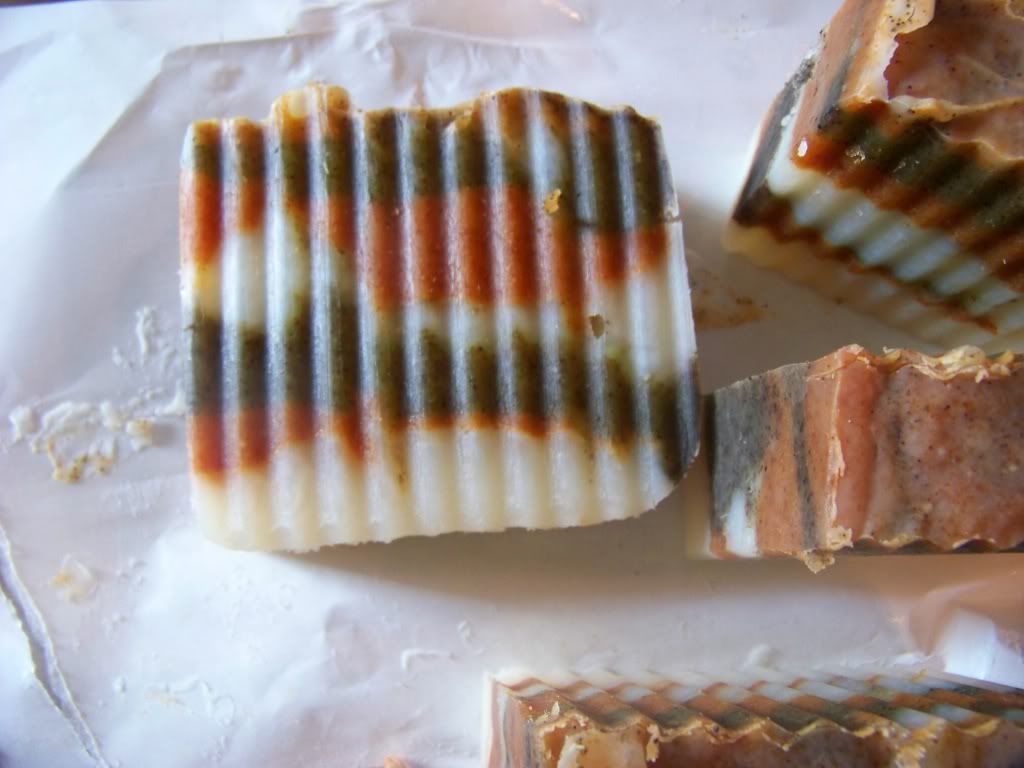
Tomato Powder makes a nice tomato red color, but it also has the scent of tomato since it is the actual dehydrated fruit.
This soap is a tomato soap and the green and brown coloring is from Neem powder.
Rattanjot will make a light lavender brown color to a deep purplish brown in your soaps.
For Browns try;

*The picture to the right is of my Kitchen/Gardener Soap. It is colored with coffee and has coffee grounds in it as well. It also has a small amount of cocoa powder sprinkled on the top.
Cocoa powder also makes a natural, deep brown that is great for contrast and swirls. Mix one tablespoon into 1/2 cup of your soap batter at trace, then mix that half cup back into your entire batter.
 The middle layer of this Citrused Lavender soap is cocoa powder. The picture isn't nearly as pretty as the soap is in real life. The brown swirly layer really pops! The bluish bottom is a combination of blueberry fibers, indigo, and vanilla powder.
*Correction! The brown in this soap is actually vanilla powder.
Coffee and Coffee Grounds also make a nice brown coloring for soap, not to mention that the grounds make a wonderful scrubbing additive.
Poppy Seeds will be a blue gray to black flecks in your soaps.
Blues are the most difficult colors to achieve naturally, but it can be done! A plant that is high in azulene will give a nice blue, even though it may fade when its left for a long period of time. So (Common) Yarrow, botanically known as Achillea Millefolium, Blue Tansy, and German Chamomile are your flowers of choice for blue.
Then there is also;
Woad Powder is a nice sky blue color in soap and you only need 1/8 to 1/2 of a teaspoon per five pound batch of soap, depending upon how deep a color you want.
And Indigo Powder, which will give you a more denim blue, but still with only 1/8 to 1/2 of a teaspoon for a five pound batch of soap!
Frequently I will mix one or more of the coloring agents to create a deeper shade of a color or even a new one all together. Play with them and find your own color combinations! The picture above is of my Orchid Rain (a proprietary blend), colored with a mixture of cranberry powder and blueberry fibers

In case I forgot to mention, as I think I did, Clays, for coloring, should be added at a rate of one tablespoon per pound of oils, either to the hot oils or at thin trace.
Tripod Thursdays- Yard Flowers and a few new soaps
Here are some yard flowers and plants, a bird that was carrying a large stick and a couple of new soaps. I had some more to get off my camera, but the charger has been misplaced and the battery is dead. So hopefully the fairies will bring it to me soon!
Tomorrow we will be finishing the exotic oils postings when we discuss Wheat Germ Oil. Now I know that this oil is not nearly as expensive as most we have talked about, but none the less, it is one that will make a great addition to your cosmetics and soaps!
Tomorrow we will be finishing the exotic oils postings when we discuss Wheat Germ Oil. Now I know that this oil is not nearly as expensive as most we have talked about, but none the less, it is one that will make a great addition to your cosmetics and soaps!
Tripod Thursdays- Spring and Summer are Coming
Since it is snowing here again......supposed to get 6-7 inches, I am dreaming of warm weather, yet again. So for todays tripod shots, I pulled photos of spring and summer flowers, beaches, and other scenery.
I took all of these shots. Most are from my home and the homes of some of my friends, but some are from our vacation in Florida, and some are "just around" pictures. I generally carry my camera with me, and am known to pull over on the side of the road to snap away. I hope that you can embrace the warmth of the seasons to come, please relax and enjoy!
I took all of these shots. Most are from my home and the homes of some of my friends, but some are from our vacation in Florida, and some are "just around" pictures. I generally carry my camera with me, and am known to pull over on the side of the road to snap away. I hope that you can embrace the warmth of the seasons to come, please relax and enjoy!
Subscribe to:
Posts (Atom)