Showing posts with label base oils. Show all posts

Teaching Tuesdays - Oils and Perfumes

Although there has been recent phenomenal growth in the "new age" practices of aromatherapy, holistic and herbal medicines, as well as various other treatments, in fact, these treatments are all quite old, ancient in fact. Massage therapy, reflexology and aromatherapy were all practiced in ancient Egypt, using many oils and perfumes that we are still familiar with today. The practical, therapeutic, social and religious uses of these oils and perfumes were depicted on many tombs and  temple walls, and recorded in texts, many of which were later copied by Greek and Roman scholars, who viewed Egypt as the source of all wisdom. It is from this documentation, thanks to Egypt's dry environment which preserved it so well, that the people of our time have been able to reconstruct many of the original ancient remedies and recipes.  


It has been proven that oils and perfumes were used in Egypt before 3100 BC., when Egypt became unified. Burials from the pre-literature period (the Predynastic period), even though they were little more than a hollow in the sand, have been recovered with "grave goods", indicating that they [already] believed in an afterlife. Aside from food and drink, the dead were often buried with cosmetics and the raw ingredients for their preparation. Of course, as the culture developed these rituals became better documented. But perfumes made of resin, lime and oil, as well as ingredients such as henna, oil-producing seeds, and imported resins, were discovered in several Predynastic era grave sites. In fact, one royal tomb, in Abydos, from c3000 BC., was found still containing jars that held their [original] contents of coniferous resin mixed with plant oils and animal fats. Another royal tomb at that same site, could easily be found by smell alone, as its sandy floors were saturated in perfume to a depth of three feet. It was still so strong that it permeated the entire tomb!

Almond oil was regarded as the finest oil in the Egyptian culture, forming the base of the majority of their most famous perfumes and medicines, as well as being used for massage. Also highly prized were the essences of lotus, cedar and cinnamon. These were prized for their own scents, as well as their value in recipes and remedies which were utilized in social and domestic contexts, religious rituals, and medicines, as well as massage and mummification procedures. In fact, these three fragrances represented the Egyptians view of life and death. The lotus flower symbolized the creation of life, while the cedar and cinnamon, both used in the mummification process, represented death and the afterlife. They played an integral part in religious ritual, which involved offerings of costly perfume, large floral bouquets and incense. The power of scent, of fragrance, was one of the ways that the Egyptians bridged the gap between the living world and the heavenly one. In fact, these fragrances were designed to reawaken the senses of the dead, which is why they were essential in the afterlife, and had to be buried with their dead.


I have read through some very detailed recipes from finds dating back to this era, and I have to say that they are recipes easily followed, and are similar to methods that were used until very recently. In fact, I believe that it is safe to say that, all perfumery and oil distillation methods grew from the ancient Egyptians, and many of these methods and recipes changed very little over thousands of years. So when you are discussing "new age" treatments and "new" fragrances, consider that your new is someone else's old!   

Teaching Tuesdays - Exotic Oils Cont.- Monoi de Tahiti

    • Continuing our exotic oils series, today we are looking at another oil that is really an infusion. This one however, unlike the calendula oil, is strictly regulated for consistency of product. I am speaking of Monoi oil, also commonly referred to as Monoi de Tahiti. This traditional product originates in French Polynesia, Tahiti, and the name "Monoï" is an ancient Tahitian word which means "scented oil."   Monoi has quite a long-established history of cosmetic use among the Tahitian people, and has been put through extensive tests and analysis in recent years, validating long-standing claims and uses for the Monoï.
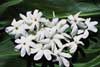
 The national flower of Tahiti, the tiare flower is a 
  • small, white, star-shaped flower, which grows on bushes that are about 3 feet tall, and can be found throughout French Polynesia. They grow in soil with a coral origin, and can be found blossoming all year long. 
Monoi de Tahiti is made by soaking these tiare flower  blossoms (gardenia taitensis)  in an enriched coconut oil. 
  • In fact, Monoi is 97% coconut oil. 
    Once the coconut oil's filtration process is completed,  it is stabilized with vitamin E, then stored in special tanks until it is purchased by the small number of monoi manufacturers, who will complete the maceration process in their individual  factories. 

    • The tiare flowers which are used are hand-picked while they are still unopened. The flowers are  immediately taken to the manufacturing plant and stripped of their pistils, where the flower portion is placed into the refined coconut oil for a minimum of 15 days. This is known as "enfleurage", or flower soaking, and a
            •  minimum of 15 tiare flowers must be soaked in every liter of refined coconut oil, according to the maceration standards. All authentic 
                                    • Tahitian monoi oil follows a strict manufacturing code, one that governs
                                    • the entire

                                    • process, a
                                        • ll the way from the handpicking of the tiare flowers to the storage and 


                                • the shipping of the final product. This process has been validated and protected 
                                • by the decree of Appellation d'Origine,  which was awarded to Monoi de Tahiti on April 1, 1992


                        • As previously mentioned, the monoi has been subjected to many studies and detailed analysis by various laboratories. In fact, the Monoi Institute of Tahiti has published the results of its studies on their web site;  www.monoi-institute.org. Other French laboratories have also published detailed analyses of this oil,  and of the tiare flower, the Tahitian gardenia blossom. These studies show that the monoi embodies many different substances that work together synergetically, benzoates, salicylates, oils and waxes, which are present in the final product because of the gentle extraction process, and the long maceration time. The end result is a product that is rich in active ingredients that will nourish the skin over many hours.  


                        Historically, Monoi was the most common remedy which the islanders used to soothe a variety of ailments. This oils' healing properties were greatly appreciated by the people, and it, in fact, remains the basis of traditional herbal medicine, even today. 
                        The Polynesians used monoi in therapeutic massage, due to its great healing powers, as well as to simply  relax muscles before canoe races or other athletic contests, and today it is still used as a wonderful massage oil . Monoi 
                        leaves the skin soft and supple, without greasiness.  It is quickly absorbed by the skin, and has proven hydrating and emollient qualities, lasting several hours beyond treatment. 
                                                • It can also be used before or after swimming, to protect the skin from the sun and other elements. Additionally, it is a natural antiseptic and can be used to prevent mosquito bites, or to soothe bites after they occur. As a hair conditioner, manoi has evidenced a reparative effect for dry and damaged hair.
                         It also makes a nice 
                              • pre-shampoo treatment, for deep conditioning and protecting. This oil makes the hair soft, silky and shiny. 
                        Of course, one of the nicest bonuses you get when using this oil, no matter what the application, is the flowery scent that emanates from the hair/skin after its use. In fact, it lasts pretty much the whole day!


                          • They say that Monoi oil is completely safe for anyone to use, and many Tahitian mothers are known to even rub it on all over their babies, every morning and evening. They report that there is no risk for allergies, and that this oil will not cause a skin reaction. Know though, that t
                                  • oday’s marketplace is flooded with monoi oil imitators, so exercise caution when purchasing.  


                        You can use this oil in any product where you would use plain coconut oil. So, in cp soap, monoi can be used as one of the base oils, generally at 30% or less, but cab be used at 60% or more of the total oils.