Skullcap, botanically known as Scutellaria lateriflora, is known as a "calming" herb, one that is good for any stressful situation, but especially for those that are grief related. Historically, Skullcap has been used to calm the mind, to stop the cycle of circular thoughts, and to ease emotional stress and tension, especially when dealing with the pain of break ups or loss. It encourages mental clarity and brings a renewed focus to thoughts, as well as actions.
It is usually made into a tincture or a tea, and has a somewhat bitter taste. Skullcap is known to stimulate digestion, and even to trigger feelings of hunger. Since the gastro-intestinal tract tends to become sluggish when we are stressed, the use of skullcap can help to return our system to health. It is said to relax tight muscles and to relieve headaches. It can be used when needed, or it can be taken daily, as a preventative treatment. When taken daily, it not only restores the body and the mind, but it works as a strengthener to prepare the body to better respond to future stresses. This herb is one that was likely in every medicine cabinet, and would do well in yours!

Showing posts with label herbs. Show all posts
Showing posts with label herbs. Show all posts

Teaching Tuesday- Calamus Root
Calamus Root, also called Acorus calamus, Sweet Flag, Cinnamon Sedge, Sweet Myrtle, Acorus, and Sweet Rush is a sharp-edged perennial. It is a semi-aquatic plant that grows in marshes and on the muddy banks of streams. Although experts usually say the plant has been used in herbal medicine as long as 4,000 years ago, the first mention of the plant as a medicine is in the Divine Husbandman's Classic of the Materia Medica, a Chinese medical text that dates to about 2837 BC. The traditional use of the calamus was to "open the orifices" to allow the inner spirit to reach out to the world. Chinese physicians (of old) reported that calamus "vaporized phlegm," but the word they used refers to not just physical phlegm, but to the "residues" of difficult emotions. Calamus was also used to treat winter-time joint pain, wounds, and sores.
In the United States and Canada, calamus was used to make calamine lotion, which was used to relieve skin inflammation, mostly from poision ivy, oak and summac. It was considered a sacred incense by the Sumerians and the Egyptians, and was planted by Native Americans along their migratory paths so that it could be harvested at later times, where it was commonly used as an antiseptic, mostly for headaches and toothaches. Oddly enough, it was also used as an attractant for muskrats, who voraciously ate the root, and often collected it and stored it in their nests for future meals. Native Americans would plant it on the edge of their villages so that they could trap the muskrats as they came for the root.
The rhizome is dried and either chopped or ground, where it is typically and traditionally used to make a tea. Varieties of calamus that are traded in the United States (and all the varieties of calamus permitted for import by Health Canada) are most effective when used externally. Theses varieties are best used as bath additives, gargles, lotions, or washes, unless they are combined with other herbs from Chinese or Ayurvedic medicine. As a bath additive, calamus helps with circulation and joint pain, used as a gargle, calamus relieves sore throat. In the United States and Canada, calamus has been used for many years to make calamine lotion, and to relieve skin inflammations of all types.
Although we may best know calamus root because of calamine lotion, if you look at Walt Whitmans famous work, Leaves of Grass, he wrote 39 poems that referred to Calamus! Even today, Ayurvedic medicine uses it as a rejuvenator of the brain and nervous system, as well as a remedy for digestive disorders. In modern Chinese medicine, calamus is used with platycodon to treat laryngitis, turmeric to treat deafness, magnolia to treat any kind of chest congestion, and is mixed with lychii fruit and chrysanthemum flowers to make a tea that is sold for use as an eyewash. It is, however, rarely found as a capsule or extract.
The FDA (Food and Drug Administration in the USA) strictly prohibits the use of calamus in food products. They have regulated this herb for external use only. Its internal use as a medicinal herbal product should only be administered by someone with experience in using this botanical. Although global cultures have, for a great many centuries, associated the consumption of calamus with a long life and good health, the American government prohibits its use in that manner.
Teaching Tuesday- Dandelions
While most people spray their lawns and try to kill the yellow "weeds" that pop up every Spring, otherwise called Dandelions (botanically known as Taraxacum officinale), most of our Grandparents, if not parents, use to gather these "weeds" for food and medicine.
Over the years, much has been written about the dandelion and its uses, and I encourage you to check into it further. While the dandelion is now considered a common weed, one that disgraces lawns everywhere, it didn't start out that way. The dandelion plant is not native. It was purposefully brought to North America by the Europeans. They brought the dandelion, chose the dandelion, because they considered it to be a valuable resource. In fact, this plant helped to keep our ancestors alive.
While we may have forgotten about this plant, it is wondrous one. In fact, every part of the dandelion can be used as food or medicine. When the first Spring leaves pop up out of the ground, dandelions can be easily harvested and eaten fresh in salads, made into a pesto, or even dried for tea. Their leaves are highly nutritious, containing large amounts of vitamin A, calcium, potassium, and several other vitamins and minerals. While long-term use of dandelion is needed for the best results, the leaves do possess diuretic properties, which makes it an inappropriate choice for anyone with low blood pressure, excessive urination, or kidney impairment. But most people tolerate dandelions just fine.
My Mother told me about gathering dandelions when she was young. They used to have them fresh, in salads, and cooked with other "greens" as a side dish. They also made poultices with dandelions, but she was too young to remember the details of making one. One use that I recently read about, but had never heard about before, is dandelion coffee. Of course you can make a dandelion tea just by drying the dandelions and then heating them in water, but making the coffee takes a bit more. Here are the directions that I found in the Healing Herbs book, written by Rosalee de la Foret.
Dandelion Coffee
• Prior to decocting the dandelion root, roast the dried chopped root in a
cast iron pan until it is fragrant and has changed color from being offwhite
to light and dark brown.
• For each 8 oz of water you are making, use 1-2 teaspoons of the
roasted root.
• Add the root to simmering water and continue to simmer while covered
for 7–15 minutes. The resulting brew will be darkly colored.
You can add milk to it, as the author of the book does, or you can add honey to sweeten it, and take the edge off.
Facing Some Face Care Challenges
Throughout history women have gone to great lengths to achieve the standard, "beautiful" face. Elizabethan women covered their faces in lead to achieve the coveted ghostly pallor that was considered beautiful in that time. Roman women use to smear wax on their wrinkles, and used mercury based lotions on their freckles and spots, in order to maintain their idea of a beautiful face.
The ancient Greeks believed that facial proportions needed to be harmonious for a woman to be beautiful, while the Victorians favored thin lips, and Rubens went for double chins and fat cheeks (many of us long for those days I think! lol).
Clearly the idea and the standard of what constitutes a beautiful face changes with time. While our society, even just a few short years ago, favored the thin bodied, with full, lush lips, today there is a large push toward more "normal" sized women, with proportionate features. However, no matter what anyone in particular identifies as beautiful, one thing is for certain, the key is clean, healthy skin.
Everyone, men and women alike, desire clean and healthy skin, and feel better when they have it. You can cover your hands and feet, and camouflage the skin in clothing, but you cannot hide your face. It is always out there for all to see. And, it is always out there taking the brunt of all the elements. Additionally, poor diet, poor sleep patterns, smoking, drinking alcohol, stress,and exposure to weather all affect the sensitive skin of the face.
Of course good habits and good health are the first key to good skin care, after all beauty (and health) comes from the inside out. But still, you can have issues, no matter your age. Actually, about 25% of adults suffer from acne, and most of theses are women. Unfortunately, the hormonal fluctuations that females endure from the teen years to menopause, trigger an increase in the production of sebum. Sebum comes from the sebaceous glands in the skin, and is the skins way to lubricate itself. It is our body's oil. When there is excess sebum it can become trapped under the dead skin cells, and block the block the pores. Blocking the pores effectively cuts off the sebum's route to [skin's] surface, which leads to inflammation inside the pores. Then the bacteria that normally lives on the skin heads to that site to feed on the trapped oil. This is when a pimple or zit pops up.
First of all we need to review the basics. Realistically, there are five steps that should be in your routine skin care plan.
1. Cleanse. This will rid your skin of dirt, makeup and oils. For this step, you should consider using a good soap adn keep the detergent bars on the shelf. In case you are new to this blog, you should know that almost every bar of soap in the big box store is actually a detergent bar. If you have to choose from commercially prepared soaps, at least choose one designed for sensitive skin. For more information on cleansing, as well as some natural recipes, see this post.
Want to make yourself a good cleanser that won't break the bank? Try this one.
2. Steam. Steam opens the skin's pores, increases the blood circulation in the facial capillaries, and deep cleans the skin. For more about steams, including recipes for steams to address various skin conditions, see this post.
3. Mask or Peel. This will further remove residue deep in the pores. It also nourishes and replenishes the skin with essential vitamins and minerals. Need some easy recipes to make masks and peels at home? See this post.
4. Tone. Toners tighten the pores and prepare the skin to accept the moisturizer. For recipes and more details about toners, see this post.
5. Moisturize. This replenishes the skin with fluid and gives it a fine coat of protective film. For recipes and more details, see this post.
Before continuing on I want to review some face care tips that we all would do well to remember;
-ALWAYS clean your face BEFORE doing a steam.
-Pull your hair back so you can get right up to the hairline.
-Should you have a flare up, do not be tempted to over-wash your face. Washing too often can strip the skin of its natural oils, as well as irritate already inflamed skin. Do not think that striping the skin's natural oils will solve your problems, because all it does is stimulate the body to produce more sebum to compensate for its loss.
-Avoid products containing heavy oils, namely petroleum by-products. When choosing makeup, avoid oil based foundations, as these tend to clog pores.
-Always remove makeup by cleansing the face before bed time. As previously stated, be sure to use a gentle cleanser. The more natural, the better.
-ALWAYS wear sunscreen when outside. That means ALWAYS, not just when you go to the beach or pool. Uv rays are always present.
-Don't forget to cleanse and care for your neck just like you care for your face. Neck skin ages the same way that the skin on your face does.
-Don't forget to moisturize above your upper lip and the area above the cheekbones, but below the eyes. These areas tend to be particularly lacking in moisture.
-Steam your skin once a week for the benefits mentioned in the steps of facial care.
-Be cautious when steaming. You do NOT want to scald the skin. If the steam is burning the inside of your nose when you breath in, wait a few minutes for the water to cool down, the try again.
-Eating more whole grains, eggs, leafy greens and broccoli will naturally increase the vitamin E in your system, and vitamin E promotes skin elasticity.
-Eating more spinach, cantaloupe, carrots and pumpkin will increase the amount of vitamin A in your diet, which lubricates and heals the skin.
So....since extra washing is not the answer when you have pimples, what else can you do, what will correct the problem? While there may be some cases where only a dermatologist consult is appropriate, certainly there are many instances where a small amount of time and an herbal remedy is the key. In fact, there are several herbs and essential oils that have been used for many years to treat skin conditions. The following is only a partial list.
Bergamot oil is primarily used for its antiseptic properties. In a facial steam it reduces redness, irritations and puffiness.
Burdock root is a herb that contains antibacterial and anti-inflammatory properties. It too has traditionally been used to treat acne, as well as other skin conditions.
Chaparral, also called “stinkweed,” is often used to treat inflammatory skin conditions such as acne, herpes, psoriasis and eczema.
Lavender is very beneficial for acne-prone skin, as it normalizes the secretions of sebaceous glands.
Neem oil has traditionally been used to treat all kinds of skin conditions. It possesses anti-inflammatory and antibacterial properties, and is said to be quite effective against acne.
In beauty treatments, rose oil is effective for treating wrinkles, puffiness and dry skin. Rosewater has anti-inflammatory, antiseptic and toning properties, and makes a great steam for any skin condition.
Witch hazel is an old, and well used treatment for psoriasis, eczema, and cracked or blistered skin. Witch hazel reduces swelling, has antiseptic properties, and even though it is a strong anti-oxidant and astringent, it also acts to soothe the skin, which makes it very useful in fighting acne. It is much more skin friendly than alcohol, which is often present in commercial astringents and toners. For more about astringents and toners, their definitions and recipes that you can make at home for skin problems, see this old post.
Yellow Dock Root also has minerals that control swelling and irritation in blocked pores.
In fact, if you look through older posts, I am sure that you will find some things mentioned that I have forgotten to include here. Generally speaking, there are several good herbs and essential oils that you can use to benefit various skin conditions. So study up, then have fun experimenting!
**Essential oils are a wonderful treatment modality. However, they need to be treated with caution and respect. Unless you are educated in their usage, please seek out a professional. Trying to formulate your own recipes with these oils when you are unaware of their proper implications, usage rates, or contraindications can be quite dangerous. So please be safe!
Teaching Tuesday- Under the Radar EO's- Lovage Leaf
We are working our way through my list of essential oils that may not have ever been on your radar before. Today we will be looking at Lovage Leaf. If you are from the UK you are probably wondering why it's in this series, because it is commonly used there. But, if you are from the US you may never have even heard of it. So we are going to remedy that today!
Lovage leaf, botanically known as Levisticum officinalis, is often called "wild celery", and is native to much of Europe and southwestern Asia, with Hungary and France being the largest producing countries. The word "lovage" comes from "love ache", "ache" being a medieval name for parsley. This plant has been cultivated in Europe for centuries, where they utilize the entire plant. The leaves are used as an herb, the roots as a vegetable, and the seeds as a spice (especially in southern European cuisine), similar to fennel seeds. Lovage tea is drunk to stimulate digestion or applied to wounds as an antispetic. And, in the UK, an alcohol lovage cordial is traditionally mixed with brandy (2:1) as a winter drink.
Lovage is a perennial plant that grows five to six feet tall in just a matter of five years time. The stems and leaves are shiny green to yellow, and flowers are produced in umbels at the stem tops, and are yellow to yellowish-green. It flowers in late spring, and the fruit matures in the autumn.
This herbaceous plant has a strong celery flavor (and scent), with a hint of anise. Its unique flavor profile can be used much like you would use celery or parsley, just use a lighter hand because it is strong. It adds great flavor to soups, stews, salads, meats and potato dishes. It is also used as a natural salt substitute, and said to be an aphrodisiac.
While every part of this plant is edible, it is only the leaves that are steam distilled for the essential oil. The Eo, just like the herb itself, has a long history of being used to treat digestive problems and skin conditions. The essential oil is considered to be a middle note, and it has a warm, fresh, sweet and spicy green fragrance.
Lovage leaf, botanically known as Levisticum officinalis, is often called "wild celery", and is native to much of Europe and southwestern Asia, with Hungary and France being the largest producing countries. The word "lovage" comes from "love ache", "ache" being a medieval name for parsley. This plant has been cultivated in Europe for centuries, where they utilize the entire plant. The leaves are used as an herb, the roots as a vegetable, and the seeds as a spice (especially in southern European cuisine), similar to fennel seeds. Lovage tea is drunk to stimulate digestion or applied to wounds as an antispetic. And, in the UK, an alcohol lovage cordial is traditionally mixed with brandy (2:1) as a winter drink.
Lovage is a perennial plant that grows five to six feet tall in just a matter of five years time. The stems and leaves are shiny green to yellow, and flowers are produced in umbels at the stem tops, and are yellow to yellowish-green. It flowers in late spring, and the fruit matures in the autumn.
This herbaceous plant has a strong celery flavor (and scent), with a hint of anise. Its unique flavor profile can be used much like you would use celery or parsley, just use a lighter hand because it is strong. It adds great flavor to soups, stews, salads, meats and potato dishes. It is also used as a natural salt substitute, and said to be an aphrodisiac.
While every part of this plant is edible, it is only the leaves that are steam distilled for the essential oil. The Eo, just like the herb itself, has a long history of being used to treat digestive problems and skin conditions. The essential oil is considered to be a middle note, and it has a warm, fresh, sweet and spicy green fragrance.
It possesses antimicrobial, antiseptic, antispasmodic, carminative, diaphoretic, digestive, diuretic, emmenagogue, expectorant, febrifuge, stimulant, and stomachic properties. Lovage is a strong oil with a distinctive aroma, therefore not much is needed in your blends.
Lovage using formulations benefit conditions of amenorrhea, anemia, congestion, cramps, dysmenorrhea, edema, flatulence, gout, indigestion, poor circulation, rheumatism, spasms, water retention, and muscle aches and pains.
A few drops in a massage oil blend will take advantage of its antispasmodic properties, and offer you an unique formula. Like wise, aging skin care formulations also benefit from the addition of this EO for its circulation building and edema decreasing attributes. I am sure you will find all kinds of formulations that will benefit from the addition of this Eo, now that's on your radar!
Oh, don't use this EO during pregnancy.

Teaching Tuesday- Under the Radar EO's- Hyssop
In continuing the series of Essential Oils that may be Under Your Radar, today we will be looking at Hyssop EO.
Hyssop is one of the bitter herbs mentioned in the Old Testament of the Bible. It was used to purify the temples. And the Romans used it to disinfect the houses of the sick, and to protect themselves against the plague.
Botanically named Hyssopus Officinalis, this brightly colored shrub ranges from roughly one to two feet tall. The base of the stem is woody and has many branches growing from it. The leaves are dark green in color and in the Spring they produce bunches of pink, blue, or (rarely) white, fragrant flowers. Under optimal weather conditions the herb hyssop is harvested twice yearly, at the end of Spring and again in the beginning of the Fall. The plants are usually flowering when harvested so that the flowing tips can be gathered. Once the stalks are cut and collected they are either hung for drying, or are stacked on pallets [to allow for drainage] and dried. After they are completely dried, about 6 days, the leaves are removed and the flowers and leaves are finely chopped. Once in this dehydrated form, the herb remains good for 18 months. The Hyssop plant is often planted by beekeepers to produce a rich and aromatic honey. The fresh herb, as well as its dried form, is commonly used in cooking. It has an intensely minty aroma and the leaves are used as an aromatic condiment. It is also used to flavor liqueur and is, in fact, part of the formulation for chartreuse. Essence of Hyssop can be obtained by steaming, and is used in cooking too, albeit to a much lesser extent.
The essential oil of Hyssop is made by steam distillation. It is a middle note, with a sweet, richly herbaceous, camphoraceous fragrance. The thjone and phenol in the plant, and the subsequent EO, give it strong antiseptic, antibacterial, and antiviral properties. It also possesses astringent, caminative, cephalic, *cicatrizant, digestive, diuretic, emmenagogue, expectorant, febrifuge, hypertensive, nervine, sedative, tonic, vermifuge, and vulnerary properties.
In the market place, hyssop is frequently used in mouthwash and eye drop formulations. In fact, the expectorant action of this oil can be put to good use during cold and flu season by adding it to a balm/rub, or by putting some in a diffuser. Aside from colds, coughs and flu, sore throats, asthma, and bronchitis, it can benefit conditions of dermatitis, eczema, fatigue, fevers, flatulence, indigestion, inflammation, leucorrhea, nervous tension, rheumatism, and wounds.
It should not be used during pregnancy, by those with high blood pressure, or by anyone with epilepsy. Hyssop has high concentrations of thujone and other chemicals that stimulate the CNS (central nervous system). These chemicals can provoke epileptic seizures when taken in high enough doses. Just how high is high enough is an unknown quantity, so best to stay away from this herb if you have any epileptic tendencies.
Hyssop is one of the bitter herbs mentioned in the Old Testament of the Bible. It was used to purify the temples. And the Romans used it to disinfect the houses of the sick, and to protect themselves against the plague.
Botanically named Hyssopus Officinalis, this brightly colored shrub ranges from roughly one to two feet tall. The base of the stem is woody and has many branches growing from it. The leaves are dark green in color and in the Spring they produce bunches of pink, blue, or (rarely) white, fragrant flowers. Under optimal weather conditions the herb hyssop is harvested twice yearly, at the end of Spring and again in the beginning of the Fall. The plants are usually flowering when harvested so that the flowing tips can be gathered. Once the stalks are cut and collected they are either hung for drying, or are stacked on pallets [to allow for drainage] and dried. After they are completely dried, about 6 days, the leaves are removed and the flowers and leaves are finely chopped. Once in this dehydrated form, the herb remains good for 18 months. The Hyssop plant is often planted by beekeepers to produce a rich and aromatic honey. The fresh herb, as well as its dried form, is commonly used in cooking. It has an intensely minty aroma and the leaves are used as an aromatic condiment. It is also used to flavor liqueur and is, in fact, part of the formulation for chartreuse. Essence of Hyssop can be obtained by steaming, and is used in cooking too, albeit to a much lesser extent.
The essential oil of Hyssop is made by steam distillation. It is a middle note, with a sweet, richly herbaceous, camphoraceous fragrance. The thjone and phenol in the plant, and the subsequent EO, give it strong antiseptic, antibacterial, and antiviral properties. It also possesses astringent, caminative, cephalic, *cicatrizant, digestive, diuretic, emmenagogue, expectorant, febrifuge, hypertensive, nervine, sedative, tonic, vermifuge, and vulnerary properties.
It should not be used during pregnancy, by those with high blood pressure, or by anyone with epilepsy. Hyssop has high concentrations of thujone and other chemicals that stimulate the CNS (central nervous system). These chemicals can provoke epileptic seizures when taken in high enough doses. Just how high is high enough is an unknown quantity, so best to stay away from this herb if you have any epileptic tendencies.
*Something that promotes the healing of a sore or wound by forming scar tissue.
Friday- More Coloring Soaps Naturally
In reviewing my Wednesday post I realized that I left Safflower off the list. So we will begin with it! Safflower will give you a nice yellow color. Add one to two teaspoons per pound of oils, depending upon the shade of yellow you desire.
Sandalwood Powder will give a purplish red to a maroon color, depending upon the PH level. A lower PH will give a more maroon coloring and a higher PH will give you a purplish coloring. Use at 1/2 teaspoon per pound of oils.
Alkanet Root Powder gives a pinkish red to a bluish purple coloring, also depending upon the PH level. A PH of 6 will have a red color, a PH of 8 will be lavender/purple, and a higher PH will be more blue. For every two ounces of base oil, infuse one tablespoon of alkanet. For your soap, add about four tablespoons per five pound batch of soap.
*of course the amount you use and the types of oils in your formulation also influence the final color.
For a green color in your soaps try some;
Burdock Leaf gives a nice, natural green. This is best when infused in a base oil, either by the hot or cold method.
Comfrey Leaf will also produce a nice, natural green. The leaves can be infused in the base oil, using one part comfrey to two parts oil, or you can add the leaf powder straight into your batch at light trace, one tablespoon per pound of oils. You can also infuse the powder into the base oil, but you will need to use a cheesecloth to strain it prior to using it.

Dandelion Leaf powder is also good for a green. Use one to two tablespoons per pound of oils at light trace, or infuse in your base oil.
Then we come to my personal favorites;
 *The above photo is of my Bamboo Soap and is made with cocoa powder and spirulina for coloring.
Nettle Leaf Powder, which gives a green that is pretty close to a lime green. It can be added directly into your soap pot or it can be infused into your base oils, whichever you prefer.
 And Spirulina, which gives a nice, rich green. This works best when added straight into the soap pot. Depending upon the shade of green desired, adding 1/2 to one teaspoon in a five pound batch is generally recommended. Although I have seen it as high as one teaspoon per pound of oils.
You can also use; French Green Clay, Alfalfa, Chlorophyll, or Olive Leaf powder for various shades of green.
Cherry Bark Powder makes a nice warm, reddish-brown color. Use two tablespoons in a five pound batch of soap. It is best to take one cup of your batter out and mix the tablespoons in. Once you have it well incorporated, mix that cup back into the whole batch.
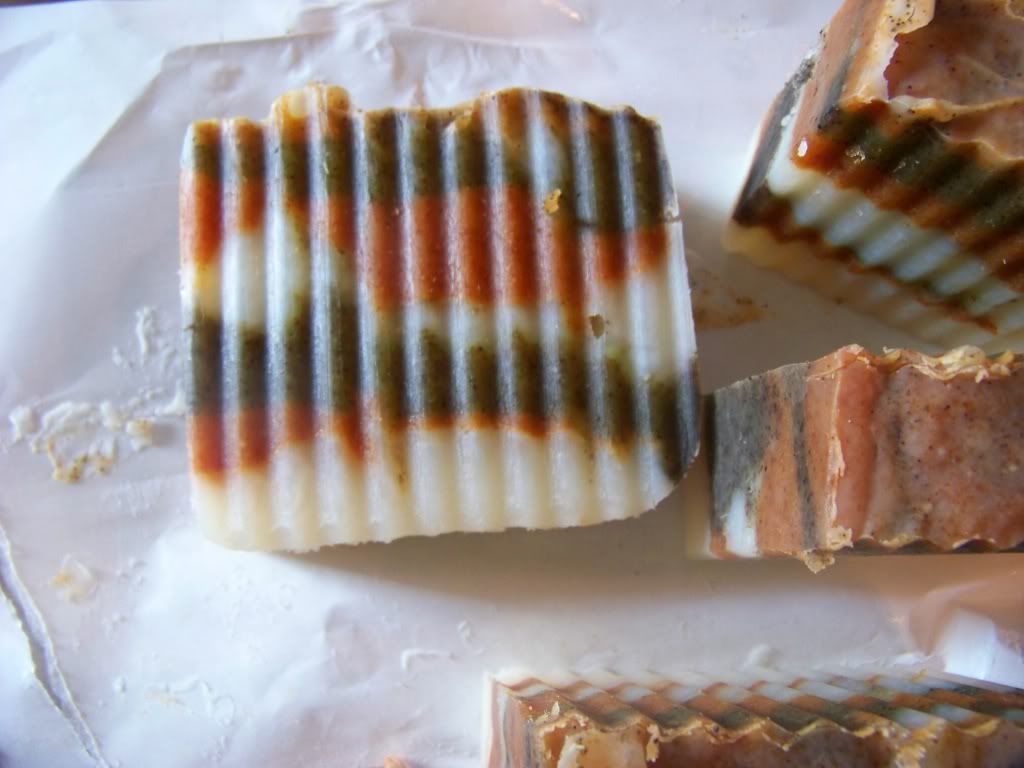
Tomato Powder makes a nice tomato red color, but it also has the scent of tomato since it is the actual dehydrated fruit.
This soap is a tomato soap and the green and brown coloring is from Neem powder.
Rattanjot will make a light lavender brown color to a deep purplish brown in your soaps.
For Browns try;
 Walnut Hull Powder will produce a rich, nutty brown color in your soap. Add 1/4 teaspoon per pound of oils. For a deep, dark brown use up to 1/2 teaspoon per pound of oils. This is a great additive for creating a swirl color or a nice contrast color.
*The picture to the right is of my Kitchen/Gardener Soap. It is colored with coffee and has coffee grounds in it as well. It also has a small amount of cocoa powder sprinkled on the top.
Cocoa powder also makes a natural, deep brown that is great for contrast and swirls. Mix one tablespoon into 1/2 cup of your soap batter at trace, then mix that half cup back into your entire batter.
 The middle layer of this Citrused Lavender soap is cocoa powder. The picture isn't nearly as pretty as the soap is in real life. The brown swirly layer really pops! The bluish bottom is a combination of blueberry fibers, indigo, and vanilla powder.
*Correction! The brown in this soap is actually vanilla powder.
Coffee and Coffee Grounds also make a nice brown coloring for soap, not to mention that the grounds make a wonderful scrubbing additive.
Poppy Seeds will be a blue gray to black flecks in your soaps.
Blues are the most difficult colors to achieve naturally, but it can be done! A plant that is high in azulene will give a nice blue, even though it may fade when its left for a long period of time. So (Common) Yarrow, botanically known as Achillea Millefolium, Blue Tansy, and German Chamomile are your flowers of choice for blue.
Then there is also;
Woad Powder is a nice sky blue color in soap and you only need 1/8 to 1/2 of a teaspoon per five pound batch of soap, depending upon how deep a color you want.
And Indigo Powder, which will give you a more denim blue, but still with only 1/8 to 1/2 of a teaspoon for a five pound batch of soap!
Frequently I will mix one or more of the coloring agents to create a deeper shade of a color or even a new one all together. Play with them and find your own color combinations! The picture above is of my Orchid Rain (a proprietary blend), colored with a mixture of cranberry powder and blueberry fibers

In case I forgot to mention, as I think I did, Clays, for coloring, should be added at a rate of one tablespoon per pound of oils, either to the hot oils or at thin trace.
Sandalwood Powder will give a purplish red to a maroon color, depending upon the PH level. A lower PH will give a more maroon coloring and a higher PH will give you a purplish coloring. Use at 1/2 teaspoon per pound of oils.
Alkanet Root Powder gives a pinkish red to a bluish purple coloring, also depending upon the PH level. A PH of 6 will have a red color, a PH of 8 will be lavender/purple, and a higher PH will be more blue. For every two ounces of base oil, infuse one tablespoon of alkanet. For your soap, add about four tablespoons per five pound batch of soap.
*of course the amount you use and the types of oils in your formulation also influence the final color.
For a green color in your soaps try some;
Burdock Leaf gives a nice, natural green. This is best when infused in a base oil, either by the hot or cold method.
Comfrey Leaf will also produce a nice, natural green. The leaves can be infused in the base oil, using one part comfrey to two parts oil, or you can add the leaf powder straight into your batch at light trace, one tablespoon per pound of oils. You can also infuse the powder into the base oil, but you will need to use a cheesecloth to strain it prior to using it.
Dandelion Leaf powder is also good for a green. Use one to two tablespoons per pound of oils at light trace, or infuse in your base oil.
Then we come to my personal favorites;

Nettle Leaf Powder, which gives a green that is pretty close to a lime green. It can be added directly into your soap pot or it can be infused into your base oils, whichever you prefer.

You can also use; French Green Clay, Alfalfa, Chlorophyll, or Olive Leaf powder for various shades of green.
Cherry Bark Powder makes a nice warm, reddish-brown color. Use two tablespoons in a five pound batch of soap. It is best to take one cup of your batter out and mix the tablespoons in. Once you have it well incorporated, mix that cup back into the whole batch.
Tomato Powder makes a nice tomato red color, but it also has the scent of tomato since it is the actual dehydrated fruit.
This soap is a tomato soap and the green and brown coloring is from Neem powder.
Rattanjot will make a light lavender brown color to a deep purplish brown in your soaps.
For Browns try;
*The picture to the right is of my Kitchen/Gardener Soap. It is colored with coffee and has coffee grounds in it as well. It also has a small amount of cocoa powder sprinkled on the top.
Cocoa powder also makes a natural, deep brown that is great for contrast and swirls. Mix one tablespoon into 1/2 cup of your soap batter at trace, then mix that half cup back into your entire batter.
 The middle layer of this Citrused Lavender soap is cocoa powder. The picture isn't nearly as pretty as the soap is in real life. The brown swirly layer really pops! The bluish bottom is a combination of blueberry fibers, indigo, and vanilla powder.
*Correction! The brown in this soap is actually vanilla powder.
Coffee and Coffee Grounds also make a nice brown coloring for soap, not to mention that the grounds make a wonderful scrubbing additive.
Poppy Seeds will be a blue gray to black flecks in your soaps.
Blues are the most difficult colors to achieve naturally, but it can be done! A plant that is high in azulene will give a nice blue, even though it may fade when its left for a long period of time. So (Common) Yarrow, botanically known as Achillea Millefolium, Blue Tansy, and German Chamomile are your flowers of choice for blue.
Then there is also;
Woad Powder is a nice sky blue color in soap and you only need 1/8 to 1/2 of a teaspoon per five pound batch of soap, depending upon how deep a color you want.
And Indigo Powder, which will give you a more denim blue, but still with only 1/8 to 1/2 of a teaspoon for a five pound batch of soap!
Frequently I will mix one or more of the coloring agents to create a deeper shade of a color or even a new one all together. Play with them and find your own color combinations! The picture above is of my Orchid Rain (a proprietary blend), colored with a mixture of cranberry powder and blueberry fibers

In case I forgot to mention, as I think I did, Clays, for coloring, should be added at a rate of one tablespoon per pound of oils, either to the hot oils or at thin trace.
Teaching Tuesday-More Healing Herbs
A few times we have gone over some of the reported healing affects of common herbs and spices. There are so many and this Fallish time of year, my thoughts are always leaning toward the herbs and spices, so here are a few more to add to your cabinet!
Winter always makes me think of Myrrh, but what is myrrh and what can it be used for? Myrrh is a resin that is highly aromatic. Aside from the luscious scent that it produces, myrrh possesses antiseptic qualities, and is, in fact, found in many commercial toothpastes. As an antiseptic, its tincture is used frequently used to treat canker sores and gum disease, as well as minor cuts. When inhaled, its volatile oil is good for relieving congestion.
Another nice Fall/Winter spice is clove. Cloves are high in antioxidants, and are antiseptic and antispasmodic in nature. Direct use of Clove oil is a safe and effective treatment for toothaches. Additionally, cloves are a proven preservative. A ham studded with cloves will last a few days longer (in the fridge) than one that does not contain the cloves. In South America, people routinely drink clove tea and liquor made from cloves, to fight digestive disorders. Since the main ingredient in cloves is eugenol, it stands to reason that this herb would be useful in combating intestinal problems, as eugenol has been known to kill bacteria and viruses for quite some time. In fact, cloves are known/proven to fight e. coli , commonly the cause of "travelers diarrhea". Besides an antispetic, the eugenol in cloves also makes the herb effective as a painkiller. Here in the USA, this generally just means that you will find clove oil as an ingredient in most over-the-counter tooth ache remedies. But in other countries, poultices of clove are often used on the skin for cuts, bites and those sort of problems. Studies have shown that clove oil can help kill several strains of staph, and even one strain of pseudomonas, organisms that can cause skin infections. Aside from utilizing the clove oil, you can also make a paste from ground up cloves and water to use as a poultice. To make clove tea (for intestinal issues), use one teaspoon of powdered cloves per cup of boiling water. Steep for ten to twenty minutes, strain and drink when cool enough.
And, of course, what cool weather herb discussion would be complete without cinnamon? Cinnamon is also an antioxidant, and has antimicrobial properties. In fact, it improves insulin sensitivity while lowering cholesterol and triglycerides. Eating 1/2 of a teaspoon twice a day, before meals, can help to lower blood sugar and cholesterol levels. Cinnamon prevents infections and fights indigestion, and has been used for thousands of years. In fact, it is mentioned by ancient Chinese herbalists as far back as 2700 B.C., and modern day Chinese herbalists still recommend it for fever, diarrhea, and menstrual problems. Cinnamon not only appears to help diabetics metabolize sugar, but it helps to soothe the stomach lining, suppress the cause of most urinary tract infections (which is e.coli), and the fungus responsible for vaginal yeast infections, cabdida albicans. Because of its tasty and versatile usage, cinnamon is probably the easiest treatment to incorporate into your life.
Winter always makes me think of Myrrh, but what is myrrh and what can it be used for? Myrrh is a resin that is highly aromatic. Aside from the luscious scent that it produces, myrrh possesses antiseptic qualities, and is, in fact, found in many commercial toothpastes. As an antiseptic, its tincture is used frequently used to treat canker sores and gum disease, as well as minor cuts. When inhaled, its volatile oil is good for relieving congestion.
Another nice Fall/Winter spice is clove. Cloves are high in antioxidants, and are antiseptic and antispasmodic in nature. Direct use of Clove oil is a safe and effective treatment for toothaches. Additionally, cloves are a proven preservative. A ham studded with cloves will last a few days longer (in the fridge) than one that does not contain the cloves. In South America, people routinely drink clove tea and liquor made from cloves, to fight digestive disorders. Since the main ingredient in cloves is eugenol, it stands to reason that this herb would be useful in combating intestinal problems, as eugenol has been known to kill bacteria and viruses for quite some time. In fact, cloves are known/proven to fight e. coli , commonly the cause of "travelers diarrhea". Besides an antispetic, the eugenol in cloves also makes the herb effective as a painkiller. Here in the USA, this generally just means that you will find clove oil as an ingredient in most over-the-counter tooth ache remedies. But in other countries, poultices of clove are often used on the skin for cuts, bites and those sort of problems. Studies have shown that clove oil can help kill several strains of staph, and even one strain of pseudomonas, organisms that can cause skin infections. Aside from utilizing the clove oil, you can also make a paste from ground up cloves and water to use as a poultice. To make clove tea (for intestinal issues), use one teaspoon of powdered cloves per cup of boiling water. Steep for ten to twenty minutes, strain and drink when cool enough.
And, of course, what cool weather herb discussion would be complete without cinnamon? Cinnamon is also an antioxidant, and has antimicrobial properties. In fact, it improves insulin sensitivity while lowering cholesterol and triglycerides. Eating 1/2 of a teaspoon twice a day, before meals, can help to lower blood sugar and cholesterol levels. Cinnamon prevents infections and fights indigestion, and has been used for thousands of years. In fact, it is mentioned by ancient Chinese herbalists as far back as 2700 B.C., and modern day Chinese herbalists still recommend it for fever, diarrhea, and menstrual problems. Cinnamon not only appears to help diabetics metabolize sugar, but it helps to soothe the stomach lining, suppress the cause of most urinary tract infections (which is e.coli), and the fungus responsible for vaginal yeast infections, cabdida albicans. Because of its tasty and versatile usage, cinnamon is probably the easiest treatment to incorporate into your life.
Teaching Tuesdays -Compress and Poultice; What are they and how do they work?
Today is Teaching Tuesday and we are going to look at the uses for a compress and a poultice, and explore just how these can benefit you and your family.
A compress consists of a pad or cloth material, cotton or gauze being the best material choice, that has been soaked in an herbal tea, decoction, or extract, and water mixture. After the appropriate tea, decoction, or extract is chosen and made, you soak the fabric in the liquid, wring it out, then apply the material to the affected area that is to be treated.
Compresses can be used either hot or cold. If swelling, muscle sprain/strain, or a headache is involved, cold is the better option. After the material has been soaked, place the compress in the freezer until it is cold, then apply it.
Sometimes it is beneficial to alternate between heated compresses and cold ones in order to help relieve pressure.
Compresses are ideal for treating, and helping to heal, muscle injuries, wounds, and other external pain. In order to know which herbs are most appropriate for which ailment(s), refer to a herbal book or chart, and look for the list of benefits and properties of the herb that you are looking for. The herbs can be used as single notes, or you can try mixing a few together for a more powerful healing whomp!
For muscle pains, try wintergreen, camphor, lemon grass, sage, or eucalyptus teas. For a headache try a cool lavender, chamomile and/or sage compress. For minor wounds or skin irritations, try rosemary, chamomile, thyme or lavender.
While similar to a compress, a poultice is when the whole herb is applied to an affected area, instead of the liquid soaked fabric. To use the herbs this way, first you must boil the fresh herb (roots can be used too). Then you actually squeeze all of the excess water out of the herb and place it on a thin
layer of gauze that is folded to keep the herb(s) sandwiched inside, then lay the whole thing over the affected area. This poultice should then stay in place for 3-4 hours, but it can be replaced with a fresh one if longer treatment is needed.
Again, the choice of herbs/roots us something that needs to be well though out and researched. However, a poultice of (either one or a combination of two or more) the herbs; rosemary, thyme, lavender or chamomile would make a strong healing poultice.
Chamomile on the skin helps to reduce redness and sooth inflamed skin, as well as being an antiseptic, bactericidal, and mild sedative.
Thyme is reputed to be strongly anti-viral, while also being considered an antibacterial agent and fungicide.
While lavender works well on all types of skin problems, it especially worlds well for healing boils, burns, sunburn, wounds, psoriasis, insect bites, and stings. Among many others, Lavender has the properties of an antiseptic, and an analgesic, an anti-inflammatory, a restorative and a mild sedative.
Rosemary also possesses many properties, but for the purpose of a poultice, it is important for its analgesic, antimicrobial, antiseptic, fungicidal, and restorative properties.
A compress consists of a pad or cloth material, cotton or gauze being the best material choice, that has been soaked in an herbal tea, decoction, or extract, and water mixture. After the appropriate tea, decoction, or extract is chosen and made, you soak the fabric in the liquid, wring it out, then apply the material to the affected area that is to be treated.
Compresses can be used either hot or cold. If swelling, muscle sprain/strain, or a headache is involved, cold is the better option. After the material has been soaked, place the compress in the freezer until it is cold, then apply it.
Sometimes it is beneficial to alternate between heated compresses and cold ones in order to help relieve pressure.
Compresses are ideal for treating, and helping to heal, muscle injuries, wounds, and other external pain. In order to know which herbs are most appropriate for which ailment(s), refer to a herbal book or chart, and look for the list of benefits and properties of the herb that you are looking for. The herbs can be used as single notes, or you can try mixing a few together for a more powerful healing whomp!
For muscle pains, try wintergreen, camphor, lemon grass, sage, or eucalyptus teas. For a headache try a cool lavender, chamomile and/or sage compress. For minor wounds or skin irritations, try rosemary, chamomile, thyme or lavender.
While similar to a compress, a poultice is when the whole herb is applied to an affected area, instead of the liquid soaked fabric. To use the herbs this way, first you must boil the fresh herb (roots can be used too). Then you actually squeeze all of the excess water out of the herb and place it on a thin
layer of gauze that is folded to keep the herb(s) sandwiched inside, then lay the whole thing over the affected area. This poultice should then stay in place for 3-4 hours, but it can be replaced with a fresh one if longer treatment is needed.
Again, the choice of herbs/roots us something that needs to be well though out and researched. However, a poultice of (either one or a combination of two or more) the herbs; rosemary, thyme, lavender or chamomile would make a strong healing poultice.
Chamomile on the skin helps to reduce redness and sooth inflamed skin, as well as being an antiseptic, bactericidal, and mild sedative.
Thyme is reputed to be strongly anti-viral, while also being considered an antibacterial agent and fungicide.
While lavender works well on all types of skin problems, it especially worlds well for healing boils, burns, sunburn, wounds, psoriasis, insect bites, and stings. Among many others, Lavender has the properties of an antiseptic, and an analgesic, an anti-inflammatory, a restorative and a mild sedative.
Rosemary also possesses many properties, but for the purpose of a poultice, it is important for its analgesic, antimicrobial, antiseptic, fungicidal, and restorative properties.
Frankly Speaking Friday
As you have probably already surmised, I love organic ingredients. The problem is that everything is very expensive these days, and organic choices are even more than their regular counterparts. This is true with food, as well as the herbs and essential oils that are needed for cosmetic/beauty ingredients. Just to give you an idea, a regular lavender essential oil (lavandula angustifolia) runs about $8.00 per ounce, while the organic one is $10-$12 per ounce. This is one reason why I maintained such a large garden at my old house. Actually, having that large garden with so much lavender in it was how/why I got started making Unique Garden Essences products, but I won't bore you with that story again. If you want to read it, you can go here.


At any rate, no matter how you look at it, living, especially trying to live healthily, costs us mo' money. So the question then becomes, how do we combat this? Well, I scrimp, save, utilize coupons and the price matching policies, and whatever else I can do for myself, rather than purchasing things that are full price. To this end, I shop sales, buy Christmas gifts in the summer, buy birthday gifts after Christmas, and of course I get up at unGodly hours to get the black Friday prices for special items.
In the food and herb department, I can, I freeze and I dehydrate a LOT of herbs, fruits and vegetables. It's amazing, because when I was young, I hated working in the garden. To me, it was not good tasting food, it was just the thing(s) that kept me home working instead of away and out riding, so I was quite resentful. And helping Mom during canning season was an even bigger pain in my hiney! Now, however, I feel privileged to have been exposed to that way of life, and I find myself wishing that I had the time and the ability to do more. But I don't, so I try do what I can.
If I need some herb that I no longer grow, first I try to find a friend that has it. If that fails, (during the spring and summer) I may purchase it from the Farmer's market or, when it is not available from the farmer's market, I buy it [fresh] in the organic section of the local warehouse type store, or the local superstore. I purchase it fresh so that I know it is organic and grown without pesticide usage. When cooking I prefer fresh, but I dehydrate the leftovers for later use. Actually, so that I will have plenty in the winter, I dehydrate the majority of my summer, outside crops. Even my year-round, indoor harvests are frequently found in the dehydrator, as I hate spoilage as much as I hate running out of things, so I like to make sure that I have a lot stored. Of course I like to use recycled containers for that storage. The drink mix containers are excellent for storing dried herbs. *They should be airtight and out of sunlight.
I have a wonderful dehydrator, with seven different layers/shelves. I use it to dehydrate fruit to eat as chips, except bananas, for some reason my bananas never come out right!, And also to grind and use in scrubs. I dehydrate herbs for teas, both the bath and the drinking kind, for poultices, for cooking, and for various skin & beauty product recipes. The dehydrator is a great tool to have. While I generally only dry one product at a time, I do mix them when I have small batches and when I know that the scents will work well together. Some of my favorite blends are lavender and sage, lavender and rosemary, lavender and eucalyptus, and any citrus with sage, chamomile, rosemary or eucalyptus. The aroma waifing throughout the house when the dehydrator is in use is like a large potpourri stewing or several of those scent plug in deals! The only smell that I wasn't that crazy about, was the venison smell when my Son used the dehydrator to make his jerky,.....but generally speaking, the scents that fill your home are great!
dried & ground orange peel, dried sage, rosemary, and eucalyptus.
Rub a Dub Dub, You Can Scrub..in the shower
Orange Zest Body Scrub
1/2 cup Sugar (white or brown)
1/4 cup Honey
1/2 cup unscented bath salt, either Dead Sea or European
1/2 cup Epson Salts
1/2 cup Coarse Sea Salt OR increase the Dead Sea or European Salts above, or mix to make 1 C
1/2 cup orange zest powder
10ml Orange (Sweet) EO
2 Tbs. Grape Seed Oil
2 Tbs. Jojoba Carrier Oil
1/4 cup Shea Butter
This scrub has a fresh, clean, orange scent that will uplift your senses as it leaves your skin moisturized, soft and silky.
Warm the Grape Seed and Jojoba oils over a very low flame, slowly, being careful to not burn the oil. Once warm, add the shea butter. When the shea butter begins to melt, remove the mixture from the stove. Stir well and allow the mixture to cool, but not harden. Then add the other ingredients one at a time, in the order shown. Be sure to add the add the essential oil last, and stir well to combine all the ingredients. Then put the mixture into plastic containers and place in the refrigerator to cool completely and harden. The oils will rise to the top and form a soft butter. The other ingredients will settle on the bottom. When it is completely cooled you can scoop it out by the handful to use (make sure you reach to the bottom to get the scrub ingredients, not just the oil). Massage it into your skin from head to toe. This scrub contains a lot of oil, which makes the tub slippery, so be careful not to slip. If you wish, you can place a towel in the tub to help prevent slipping. Happy scrubbing!!!! The shelf life of this product is pretty long even without a preservative because of the honey, essential oil and salt, but be sure not to get any water into it as you use it, or you'll risk bacterial growth. As always, use the freshest oils possible for best results!
Honey Lemon Sugar Scrub
4 tsp lemon juice
4 drops Lemon EO
4Tbs. honey
1/2 cup Sweet Almond Oil
2 1/2 cups Sugar
Combine the sugar and sweet almond oil in a large bowl and stir well to combine. Add the lemon juice and stir again. Finally, add the honey and lemon essential oil and stir again to mix. You should have a grainy paste. To use, stand naked in a tub or shower and scoop the scrub using your palms. Begin massaging body, extremities first, in circular motions to exfoliate and cleanse.This mixture is oily and so you will have to be especially careful that you do not slip in the tub! After you're finished, you can cleanse with soap or bath gel as usual if you'd like to remove some of the excess oil from your skin ... which should feel polished and luxuriant after your treatment! You can make this recipe ahead of time and store it in the refrigerator, but allow it sit before use until it reaches room temperature, then stir well to mix before using. It should last a few weeks if you use fresh ingredients and store it in an airtight container.
Gingerbread Body Scrub
1 tsp cocoa powder
3/4 cup brown sugar
2 drops Ginger EO
1 Tbs. Jojoba Oil
1 tsp freshly grated ginger
Measure all of the ingredients into a bowl and mix well. To use in the shower, scoop up some of the scrub and rub it in circular motions all over your body. Rinse well with warm water and pat dry. This scrub really smells great!
Cinnamon is for More Than Sugar Toast!
Cinnamon comes from the bark of a tree, and cinnamon sticks are actually pieces of that bark. The tree grows from 20 to 30 feet high and it has a thick, scabrous bark with strong branches.
As early as 2700 B.C., this spice was mentioned by ancient Chinese herbalists. It was an ingredient in the embalming mixtures of ancient Egypt, and the Bible says that Moses used it as a holy anointing oil. After the fall of the Roman empire, when trade between Europe and Asia became difficult, Cinnamon was extremely prized. It found its way west, and by the twelfth century, German herbalists recommended cinnamon as the "universal spice for sinuses." They recommended it be used to treat colds, flu, cancer, and many other internal ailments.
The word cinnamon can refer to the "origional" cinnamon, Cinnarmomum zeylanicum of Ceylon, or the product of the Cassia tree, which is usually regarded as a substitute for Cinnarmomum zeylanicum of Ceylon because it VERY closely resembles the Ceylon. It possesses much the same qualities and constitu ents, but it is inferior. It is also much cheaper and more abundant than the Ceylon variety, hence the reason for its popularity. As a matter of fact, it is now the only official oil of cinnamon in the United States and German Pharmacopoeias.
Cinnamon has been used medicinally for thousands of years, and now modern science has confirmed its value as an anti-infective and digestive aide. Cinnamon possesses antiseptic qualities which kill many disease causing viruses and fungi. It is no accident that cinnamon is frequently used in toothpaste. Besides tasting good, cinnamon is known to kill the bacteria that cause tooth decay and gum disease. According to some overseas studies, cinnamon suppresses the cause of most urinary tract infections and kills the fungus responsible for vaginal yeast infections. They also report that it helps to prevent stomach ulcers. Cinnamon, like many culinary spices, is known to soothes the stomach. According to the US department of agriculture (USDA), it also appears that cinnamon helps diabetics metabolize sugar by reducing the amount of insulin necessary for glucose metabolism. As little as "one eighth of a teaspoon of cinnamon triples insulin efficiency," per Dr. James Duke, author of The CRC Handbook of Medicinal Herbs.
In its powdered form, culinary amounts of cinnamon are nontoxic, although allergic reactions are possible. Cinnamon oil, however, is a completely different story. If someone were to swallow it, they would likely experience nausea and vomiting, and quite possibly kidney damage. While some herbalists taught cinnamon oil as a skin conditioner and anti-inflammatory agent, others maintain that it doesn't provide any dermal benefits. No matter your stance on this issue, everyone agrees that cinnamon oil is a known dermal (skin) toxin, irritant, and sensitizer. It is also known to irritate mucous membranes. Since it may cause redness and burning on the skin, if you make a product containing the oil, be sure to highly dilute it. If you are using someone else's product that has cinnamon oil as an ingredient, including soaps and lip balms, remember that you really don't know how concentrated they left the cinnamon. Do not take make the mistake of assuming, perform a patch test to make sure that the product will not negatively impact your skin.
You can enjoy cinnamon in foods, simply seasoned to taste, or you can brew a tea and drink it. To make a tea, use 1/2 to 3/4 teaspoon of the powdered herb per cup of boiling water. Steep the powder for ten to twenty minutes. You may drink up to three cups per day. Whatever you do, NEVER use the essential oil internally.
ents, but it is inferior. It is also much cheaper and more abundant than the Ceylon variety, hence the reason for its popularity. As a matter of fact, it is now the only official oil of cinnamon in the United States and German Pharmacopoeias.
Cinnamon has been used medicinally for thousands of years, and now modern science has confirmed its value as an anti-infective and digestive aide. Cinnamon possesses antiseptic qualities which kill many disease causing viruses and fungi. It is no accident that cinnamon is frequently used in toothpaste. Besides tasting good, cinnamon is known to kill the bacteria that cause tooth decay and gum disease. According to some overseas studies, cinnamon suppresses the cause of most urinary tract infections and kills the fungus responsible for vaginal yeast infections. They also report that it helps to prevent stomach ulcers. Cinnamon, like many culinary spices, is known to soothes the stomach. According to the US department of agriculture (USDA), it also appears that cinnamon helps diabetics metabolize sugar by reducing the amount of insulin necessary for glucose metabolism. As little as "one eighth of a teaspoon of cinnamon triples insulin efficiency," per Dr. James Duke, author of The CRC Handbook of Medicinal Herbs.
In its powdered form, culinary amounts of cinnamon are nontoxic, although allergic reactions are possible. Cinnamon oil, however, is a completely different story. If someone were to swallow it, they would likely experience nausea and vomiting, and quite possibly kidney damage. While some herbalists taught cinnamon oil as a skin conditioner and anti-inflammatory agent, others maintain that it doesn't provide any dermal benefits. No matter your stance on this issue, everyone agrees that cinnamon oil is a known dermal (skin) toxin, irritant, and sensitizer. It is also known to irritate mucous membranes. Since it may cause redness and burning on the skin, if you make a product containing the oil, be sure to highly dilute it. If you are using someone else's product that has cinnamon oil as an ingredient, including soaps and lip balms, remember that you really don't know how concentrated they left the cinnamon. Do not take make the mistake of assuming, perform a patch test to make sure that the product will not negatively impact your skin.
You can enjoy cinnamon in foods, simply seasoned to taste, or you can brew a tea and drink it. To make a tea, use 1/2 to 3/4 teaspoon of the powdered herb per cup of boiling water. Steep the powder for ten to twenty minutes. You may drink up to three cups per day. Whatever you do, NEVER use the essential oil internally.
 ents, but it is inferior. It is also much cheaper and more abundant than the Ceylon variety, hence the reason for its popularity. As a matter of fact, it is now the only official oil of cinnamon in the United States and German Pharmacopoeias.
Cinnamon has been used medicinally for thousands of years, and now modern science has confirmed its value as an anti-infective and digestive aide. Cinnamon possesses antiseptic qualities which kill many disease causing viruses and fungi. It is no accident that cinnamon is frequently used in toothpaste. Besides tasting good, cinnamon is known to kill the bacteria that cause tooth decay and gum disease. According to some overseas studies, cinnamon suppresses the cause of most urinary tract infections and kills the fungus responsible for vaginal yeast infections. They also report that it helps to prevent stomach ulcers. Cinnamon, like many culinary spices, is known to soothes the stomach. According to the US department of agriculture (USDA), it also appears that cinnamon helps diabetics metabolize sugar by reducing the amount of insulin necessary for glucose metabolism. As little as "one eighth of a teaspoon of cinnamon triples insulin efficiency," per Dr. James Duke, author of The CRC Handbook of Medicinal Herbs.
In its powdered form, culinary amounts of cinnamon are nontoxic, although allergic reactions are possible. Cinnamon oil, however, is a completely different story. If someone were to swallow it, they would likely experience nausea and vomiting, and quite possibly kidney damage. While some herbalists taught cinnamon oil as a skin conditioner and anti-inflammatory agent, others maintain that it doesn't provide any dermal benefits. No matter your stance on this issue, everyone agrees that cinnamon oil is a known dermal (skin) toxin, irritant, and sensitizer. It is also known to irritate mucous membranes. Since it may cause redness and burning on the skin, if you make a product containing the oil, be sure to highly dilute it. If you are using someone else's product that has cinnamon oil as an ingredient, including soaps and lip balms, remember that you really don't know how concentrated they left the cinnamon. Do not take make the mistake of assuming, perform a patch test to make sure that the product will not negatively impact your skin.
You can enjoy cinnamon in foods, simply seasoned to taste, or you can brew a tea and drink it. To make a tea, use 1/2 to 3/4 teaspoon of the powdered herb per cup of boiling water. Steep the powder for ten to twenty minutes. You may drink up to three cups per day. Whatever you do, NEVER use the essential oil internally.
ents, but it is inferior. It is also much cheaper and more abundant than the Ceylon variety, hence the reason for its popularity. As a matter of fact, it is now the only official oil of cinnamon in the United States and German Pharmacopoeias.
Cinnamon has been used medicinally for thousands of years, and now modern science has confirmed its value as an anti-infective and digestive aide. Cinnamon possesses antiseptic qualities which kill many disease causing viruses and fungi. It is no accident that cinnamon is frequently used in toothpaste. Besides tasting good, cinnamon is known to kill the bacteria that cause tooth decay and gum disease. According to some overseas studies, cinnamon suppresses the cause of most urinary tract infections and kills the fungus responsible for vaginal yeast infections. They also report that it helps to prevent stomach ulcers. Cinnamon, like many culinary spices, is known to soothes the stomach. According to the US department of agriculture (USDA), it also appears that cinnamon helps diabetics metabolize sugar by reducing the amount of insulin necessary for glucose metabolism. As little as "one eighth of a teaspoon of cinnamon triples insulin efficiency," per Dr. James Duke, author of The CRC Handbook of Medicinal Herbs.
In its powdered form, culinary amounts of cinnamon are nontoxic, although allergic reactions are possible. Cinnamon oil, however, is a completely different story. If someone were to swallow it, they would likely experience nausea and vomiting, and quite possibly kidney damage. While some herbalists taught cinnamon oil as a skin conditioner and anti-inflammatory agent, others maintain that it doesn't provide any dermal benefits. No matter your stance on this issue, everyone agrees that cinnamon oil is a known dermal (skin) toxin, irritant, and sensitizer. It is also known to irritate mucous membranes. Since it may cause redness and burning on the skin, if you make a product containing the oil, be sure to highly dilute it. If you are using someone else's product that has cinnamon oil as an ingredient, including soaps and lip balms, remember that you really don't know how concentrated they left the cinnamon. Do not take make the mistake of assuming, perform a patch test to make sure that the product will not negatively impact your skin.
You can enjoy cinnamon in foods, simply seasoned to taste, or you can brew a tea and drink it. To make a tea, use 1/2 to 3/4 teaspoon of the powdered herb per cup of boiling water. Steep the powder for ten to twenty minutes. You may drink up to three cups per day. Whatever you do, NEVER use the essential oil internally.
Add Some Pep With Peppermint!
Get Peppy With Peppermint
The herb peppermint is utilized in many products. Everything from candy, to mouthwash to medicine, contain the flavor of peppermint. But peppermint is more than just a pleasant taste, it has been used for centuries to aide with digestion. In fact, the custom of having an after dinner mint was begun by the ancient Romans, when they ate mint after their meals to aide with the digestion of the meal. Peppermint was recommended by American herbalists for gas, colic, hiccups, and nausea, as early as 1801. Peppermint is probably the best known remedy for stomach ailments. The essential oils in peppermint stimulate the gallbladder and encourage bile secretion, while helping the muscles that line the stomach and the intestines to smooth out and function properly. In fact, in recent years, research has shown that peppermint is very helpful for irritable bowel syndrome, which is a common, hard to treat ailment. Peppermint oil, in extremely high concentrations, may also inhibit and/or kill many microorganisms associated with digestive and other problems.
The chemical in the plants volatile oil which makes it so potent and effective as a health aide, is menthol. Menthol, albeit usually a synthetic version, is used in many health care products, for clearing congestion, opening airways, and topically for easing muscle pain and cooling inflammation.
While peppermint tea is widely used to receive digestive upset, it is not really recommended for colicky infants because the menthol may cause them to experience a choking sensation. Even in older children, a weakened dilution is recommended. Additionally, please remember that essential oils are highly concentrated and should only be used by drops. In fact, pure menthol is poisonous and should not be used internally.
While spearmint is a related plant, and is also used for flavoring, it is not considered medicinally potent like peppermint, so if you are in need make sure to use peppermint.
Peppermint is purported to help;
- ease intestinal gas
- relieve indigestion and diarrhea
- relieve congestion
- soothe muscle soreness
- treat irritable bowel syndrome
- calm menstrual cramps
_____RECIPES FOR YOU____
Want to make your own breath mints? They aren't that difficult, try this recipe.
1 3/4 cup sugar
1/4 cup honey
3/4 cup light corn syrup
1/2 tsp peppermint extract (you can also use spearmint, or wintergreen. Adding lemon extract instead of the peppermint will make this a great cough/sore throat drop. Adding comfrey and pepsin, in addition to the lemon, will make this a great stomach relief drop.)
1/2 cup water
*You can also add vitamin C if you want to fortify these drops
- Line a 9x9 baking pan with aluminum foil, making sure that the foil continues up the sides of the pan.
- Butter the sides of a 2 qt sauce pan.
- Combine the sugar, corn syrup, water and honey in the sauce pan. Cook and stir over medium-high heat until the mixture boils, stirring constantly to dissolve the sugar (this usually takes about 4-6 minutes).
- Turn the heat down to medium and continue a light boil at a steady rate, stirring occasionally, until at the soft crack stage, 290 degrees on a candy thermometer.
- Continue to cook for 20 minutes, stirring occasionally.
- Remove from heat and allow to cool, stirring occasionally over the next 2-3 minutes. Add the peppermint extract (other herbs or vitamins should be added now if you desire them).
- Immediately pour the mixture into the foil lined pan and allow to cool for 5-10 minutes, then go ahead and "mark" your break lines into the mixture with a spatula. Make the portions square and small/large enough for a single serving. If the marks do not stay as the mixture sets up, it means that it was too hot, so mark again and allow it to cool more.
- Allow the mixture to set overnight, then use the foil to lift the batch from the pan. Break along your marks, and package in individual candy wrappers which can be purchased in the crafting section of grocery stores, or at cake decorating shops. Of course, you can simply use wax paper if you'd prefer.
- Make sure that you store these in a cool, dark place until you need them. This batch will make about 200 portions, depending upon the size you make them. they should be good for about 6-8 months, but you will need to wrap them well, then store them in a plastic or paper bag.
- Mix all together and store in a dark, glass bottle. This mixture will keep for 1-2 months if you use the alcohol, but has no shelf life without it, so mix and use as needed.
- *You can use food coloring to color the mixture if you'd like
- Mix together and use a cheese shaker to sprinkle onto your wet toothbrush. Use as you would a store purchased toothpaste.
- This will only remain good for about 2 weeks, so do not make a batch at a time.
SSSSSSSSSome More Essential Oils
Today's Neat-O shop is http://cthings.etsy.com . Stop in and see all the pretty jewelry!
-SAGE has a fresh, warm-spicy, herbaceous, and somewhat camphorus scent.
-SANDALWOOD has a deep, soft, sweet-woody balsamic scent.
-SPEARMINT has a warm, spicy-herbaceous, minty fragrance.
-
More Essential Oils
*This content of this page has been deleted due to my impending book
-SAGE has a fresh, warm-spicy, herbaceous, and somewhat camphorus scent.
-SANDALWOOD has a deep, soft, sweet-woody balsamic scent.
-SPEARMINT has a warm, spicy-herbaceous, minty fragrance.
-
A rose is a rose is a rose, but it is worth the cost!
The Neat-O featured shop for today is http://glitterstar.etsy.com. Check out this shop for interesting bead and duct tape jewelry!
-ROSE Essential oil is a very expensive oil and how expensive largely depends upon the manner of distillation. From rosa damascena you can purchase Rose Absolute Oil for approx. $155 an ounce. This is solvent extracted oil, from fresh petals, or you can buy Rose (Bulgarian) Essential Oil, also made from the fresh petals, but steam distilled at about $380 an ounce!
Lesser is not always better though. The absolute oil is NOT therapeutic grade quality due to the solvents used in its distillation process. As for scent, they both produce a rich scent, but the absolute oil has a sweet, spicy-floral, tenacious odor, while the Bulgarian is deeper, richer and has more of a sweet-floral scent that is also slightly spicy.
There are some 250 species of roses............,
-ROSEMARY essential oil has a fresh, strong, minty-herbaceous scent, with a woody-balsamic undertone. It is largely produced by Spain, France, and Tunisia. The rosemary plant was ......
This oil should not be used during pregnancy or by epileptics. It is also contraindicated for people with high blood pressure.
-ROSEWOOD essential oil has a very sweet, floral, wood scent with a hint of spice. It comes mainly from ......
ESSENTIAL OILS CONTINUED
*The majority of this post has been deleted due to my impending book
Lesser is not always better though. The absolute oil is NOT therapeutic grade quality due to the solvents used in its distillation process. As for scent, they both produce a rich scent, but the absolute oil has a sweet, spicy-floral, tenacious odor, while the Bulgarian is deeper, richer and has more of a sweet-floral scent that is also slightly spicy.
There are some 250 species of roses............,
-ROSEMARY essential oil has a fresh, strong, minty-herbaceous scent, with a woody-balsamic undertone. It is largely produced by Spain, France, and Tunisia. The rosemary plant was ......
This oil should not be used during pregnancy or by epileptics. It is also contraindicated for people with high blood pressure.
-ROSEWOOD essential oil has a very sweet, floral, wood scent with a hint of spice. It comes mainly from ......
Mmmmmm, More Essential Oils!
The NeatO shop featured for today's shopping pleasure is the Little Pink Plumb.Please visit the shop and see all the cool pocket mirrors at http://littlepinkplum.etsy.com
*THE MAJORITY OF THIS POST WAS DELETED DUE TO MY IMPENDING BOOK
ESSENTIAL OILS
-MARJORAM (Sweet) has a warm, herbaceous, nutty, and woody fragrance. Its use should be avoided during pregnancy.-MELISSA is lemon balm and has the same properties of lemon, so see the lemon entry.
-MYRRH is a hot, smoky, herbaceous, woody, yet dry scent. . Its use during pregnancy is not recommended and *it is not for internal use at all.
-MYRTLE has a clear, fresh, camphoraceous, sweet-herbaceous odor. Its use while pregnant is not recommended.
-NEROLI OIL has a light, sweet-floral fragrance, with a terpeny top note.
Getting into Hot Water
Step Two to Facial Care is the STEAM. Steam opens and cleanses the pores, while increasing blood circulation to facial capillaries. Steam deep cleanses the skin. You should steam cleanse at least one time per week. Make sure that you clean your face prior to steaming. In other words,
there is a reason that steaming is step TWO. You want the steam to work on the deep pore grime, not surface dirt! If you are going to skip steps in your facial routine, make sure you at least moisturize after the steam.
***All steams, unless otherwise noted, require 1 gallon of ALMOST boiling water. Once the recipe is prepared, you will need to place a towel over your head and lean your face over the bowl, about 12 inches away, to absorb the steam and vapors. Don't forget to exercise extreme caution so that you don't scald your skin. If the inside of your nose feels like it is burning, wait a few minutes for the water to cool down before you try again.
Heat breaks down some essential oils, therefore you may need to allow the water to cool slightly before mixing in certain oils in order to maintain their full therapeutic value.***
*Rose Petal Facial Steam, for normal skin:
*Rosemary Peppermint Facial Steam
 This steam is not only helpful in opening the pores and extracting the skin's impurities, it is also known to clear sinuses and alleviate headaches.
*Oily Skin Sauna
*Sauna for Blemished Skin
*Ultimate Spa-Type Facial Steam for all skin types
there is a reason that steaming is step TWO. You want the steam to work on the deep pore grime, not surface dirt! If you are going to skip steps in your facial routine, make sure you at least moisturize after the steam.
***All steams, unless otherwise noted, require 1 gallon of ALMOST boiling water. Once the recipe is prepared, you will need to place a towel over your head and lean your face over the bowl, about 12 inches away, to absorb the steam and vapors. Don't forget to exercise extreme caution so that you don't scald your skin. If the inside of your nose feels like it is burning, wait a few minutes for the water to cool down before you try again.
Heat breaks down some essential oils, therefore you may need to allow the water to cool slightly before mixing in certain oils in order to maintain their full therapeutic value.***
*Rose Petal Facial Steam, for normal skin:
- Put 1 cup of fresh rose petals (roses are often treated to enhance color and increase longevity, so make sure that the ones you use are not chemically treated in any way) into a large bowl and pour 1 gallon of almost boiling water over them. Steam, breathing in the vapors, for 15 minutes, then gently pat dry.
*Rosemary Peppermint Facial Steam
 This steam is not only helpful in opening the pores and extracting the skin's impurities, it is also known to clear sinuses and alleviate headaches.
- After the almost boiling (1 gallon) water cools slightly, add 4 drops of peppermint and 4 drops of rosemary essential oils. Steam for 10 minutes, pat dry.
*Oily Skin Sauna
- Add 6 drops of lavender essential oil to a gallon of almost boiling water. Steam for 10 minutes, pat dry.
*Sauna for Blemished Skin
- Add 12 drops of bergamot essential oil to a gallon of almost boiling water. Blemished skin should not steam for longer than 5 minutes. Pat dry.
*Ultimate Spa-Type Facial Steam for all skin types
- Add 2 drops each of bergamot, geranium, lavender and clary sage essential oils. Steam for 3 minutes, then pat dry.
Subscribe to:
Posts (Atom)